How to Verify a Car Before Buying in Nigeria: VIN, Customs, Documents & Ownership Checks (2026)
Buying a car in Nigeria is not simply about finding a vehicle you like and negotiating the price. Before you transfer money, you need to establish that the vehicle is genuine, its identifying details match its records, its documentation is legitimate, and the person selling it has the right to sell it.
This is where car verification becomes critical.
A car can look clean, drive perfectly and still have problems hidden behind the paperwork. It could have a questionable VIN, unresolved customs issues, inconsistent ownership records, accident history, altered mileage or documentation that does not match the vehicle.
In this guide, MondeRides explains how to verify a car in Nigeria before buying it, including VIN verification, customs verification, ownership checks, vehicle documents, physical inspection and the red flags that should make you walk away from a deal.
Important: No single check proves that a vehicle is completely safe to buy. A proper verification process combines documentation, VIN checks, physical inspection, ownership verification and professional assessment.
Why You Should Verify a Car Before Buying
The biggest mistake a car buyer can make is treating the seller's word as the verification process.
A seller may tell you:
- "The papers are complete."
- "The car is clean."
- "The VIN is correct."
- "Customs has cleared it."
- "The car belongs to my brother."
- "There was never an accident."
- "The mileage is original."
None of these statements should replace independent verification.
A vehicle is a major financial purchase. If you discover a serious problem after payment, recovering your money can become extremely difficult.
Verification helps you identify problems before your money leaves your account.
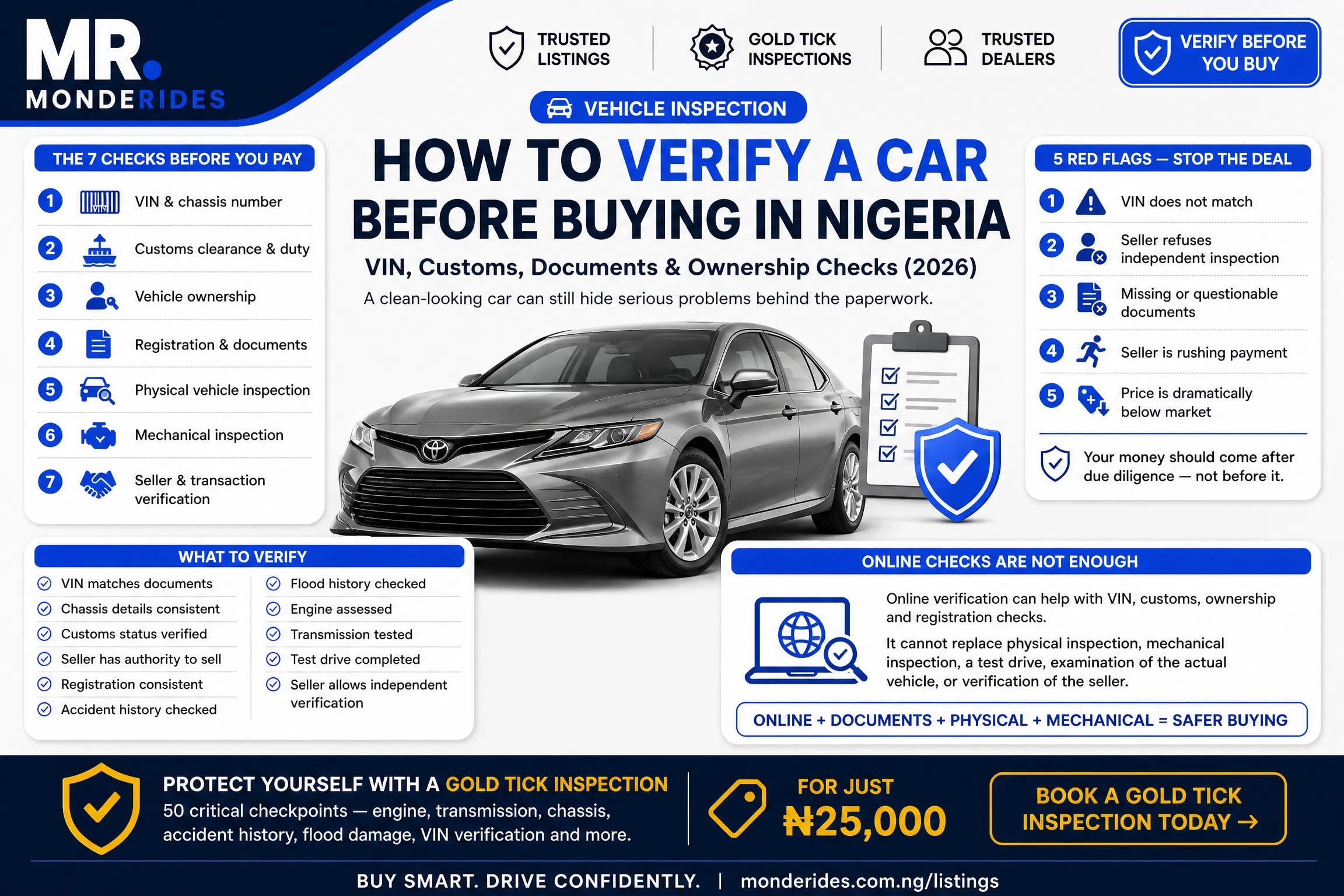
The 7 Checks to Perform Before Buying a Car in Nigeria
A proper verification process should include:
- VIN and chassis number verification
- Customs clearance and duty verification
- Vehicle ownership verification
- Registration and vehicle-document checks
- Physical vehicle inspection
- Mechanical inspection
- Seller and transaction verification
Let's look at each one.
1. Check the VIN and Chassis Number
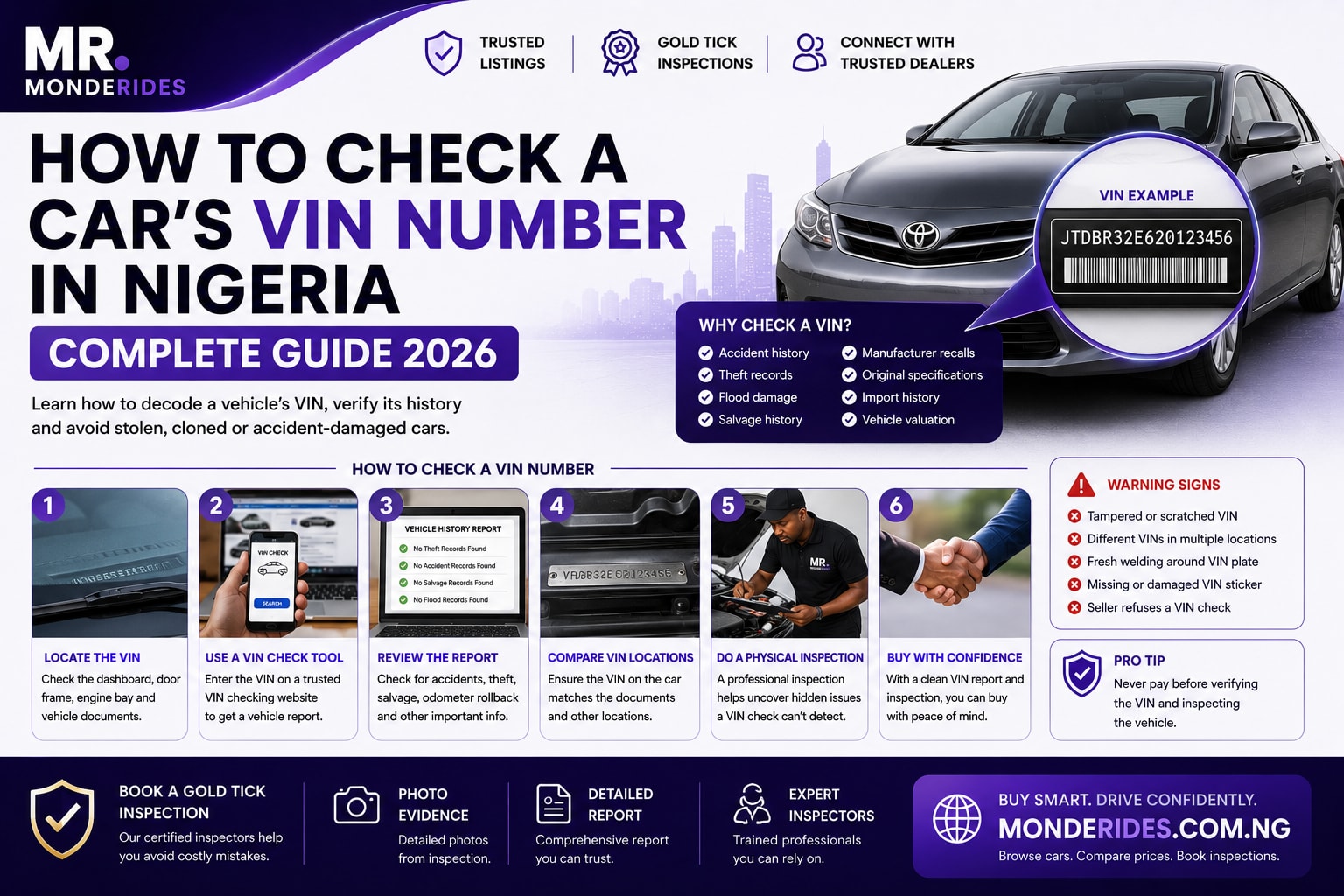
The Vehicle Identification Number (VIN) is one of the most important identifiers on a vehicle.
Most modern vehicles have a 17-character VIN. Depending on the vehicle, you may find it on the dashboard near the windscreen, driver's-side door jamb, engine bay, chassis or vehicle documentation.
Do not simply copy the VIN from the seller's advert.
Physically locate the VIN on the vehicle and compare it with the VIN appearing on the documents.
What should match?
At minimum, compare:
- VIN
- Chassis number where applicable
- Vehicle make
- Model
- Year
- Engine information where recorded
- Colour
- Registration details
- Other identifying information contained in the documents
If the VIN on the vehicle does not match the VIN on the documents, stop the transaction until the discrepancy has been properly explained and independently verified.
A mismatch is not something you should ignore because "the seller said it is normal."
Can a VIN check prove everything?
No.
A VIN check is an important part of verification, but it does not replace physical inspection or ownership verification.
Your existing MondeRides guide explains the VIN process in more detail:
How to Check a Car's VIN Number in Nigeria
2. Verify the Vehicle's Customs Status
For imported vehicles, customs documentation is an important part of the verification process.
The Nigeria Customs Service (NCS) has introduced the Customs Verification Management System (CVMS), which uses a vehicle's VIN or chassis number to verify vehicle clearance and duty status.
According to the NCS, the system can confirm whether import duty has been duly paid and can generate a customs verification receipt containing a unique reference number and QR code.
This is particularly important when buying a Tokunbo or other imported vehicle.
What should you do?
Ask the seller for the relevant customs information and independently verify the vehicle rather than relying only on a screenshot or document sent through WhatsApp.
The VIN or chassis number should correspond with the vehicle you are physically inspecting.
Be careful with "customs papers"
A document that looks official is not automatically proof that the vehicle's customs status is legitimate.
Where possible, verify information through the appropriate official Nigeria Customs Service systems.
The Nigeria Customs Service currently lists its Customs Verification Management System among its official services.
3. Verify Ownership
You also need to establish who legally owns the vehicle and whether the person selling it has the authority to sell it.
This becomes especially important when the seller says:
"I'm selling it for my friend."
or:
"The owner is outside the country."
or:
"My brother asked me to sell it."
These situations are not automatically fraudulent, but they require additional caution.
The Federal Road Safety Corps provides an official Proof of Ownership Verification Platform designed to help users verify vehicle ownership information.
Ask questions such as:
- Who is the registered owner?
- Does the seller's identity correspond with the ownership records?
- If someone else is selling the vehicle, what is their authority to do so?
- Are the ownership documents consistent?
- Is there any unexplained change in ownership?
- Does the seller have the original documentation required for the transaction?
Do not assume that possession of a vehicle means ownership.
Someone can physically possess a vehicle without having the legal authority to sell it.
4. Check the Vehicle Documents Carefully
Before paying for a used car, inspect the available documentation.
Depending on the vehicle and its history, documentation may include registration-related records, proof of ownership, customs documentation and other transaction or vehicle records.
The key principle is simple:
The information on the documents should correspond with the actual vehicle.
Look for consistency in:
- VIN
- Chassis number
- Registration number
- Make
- Model
- Vehicle colour
- Owner information
- Other identifying information
What if one document has different information?
Do not immediately assume it is a harmless clerical error.
Ask the seller to explain the discrepancy and independently confirm the correct information before proceeding.
A small documentation inconsistency can sometimes reveal a much bigger problem.
5. Inspect the Vehicle Physically
Paperwork is only one side of vehicle verification.
A car can have apparently convincing documentation and still have serious physical problems.
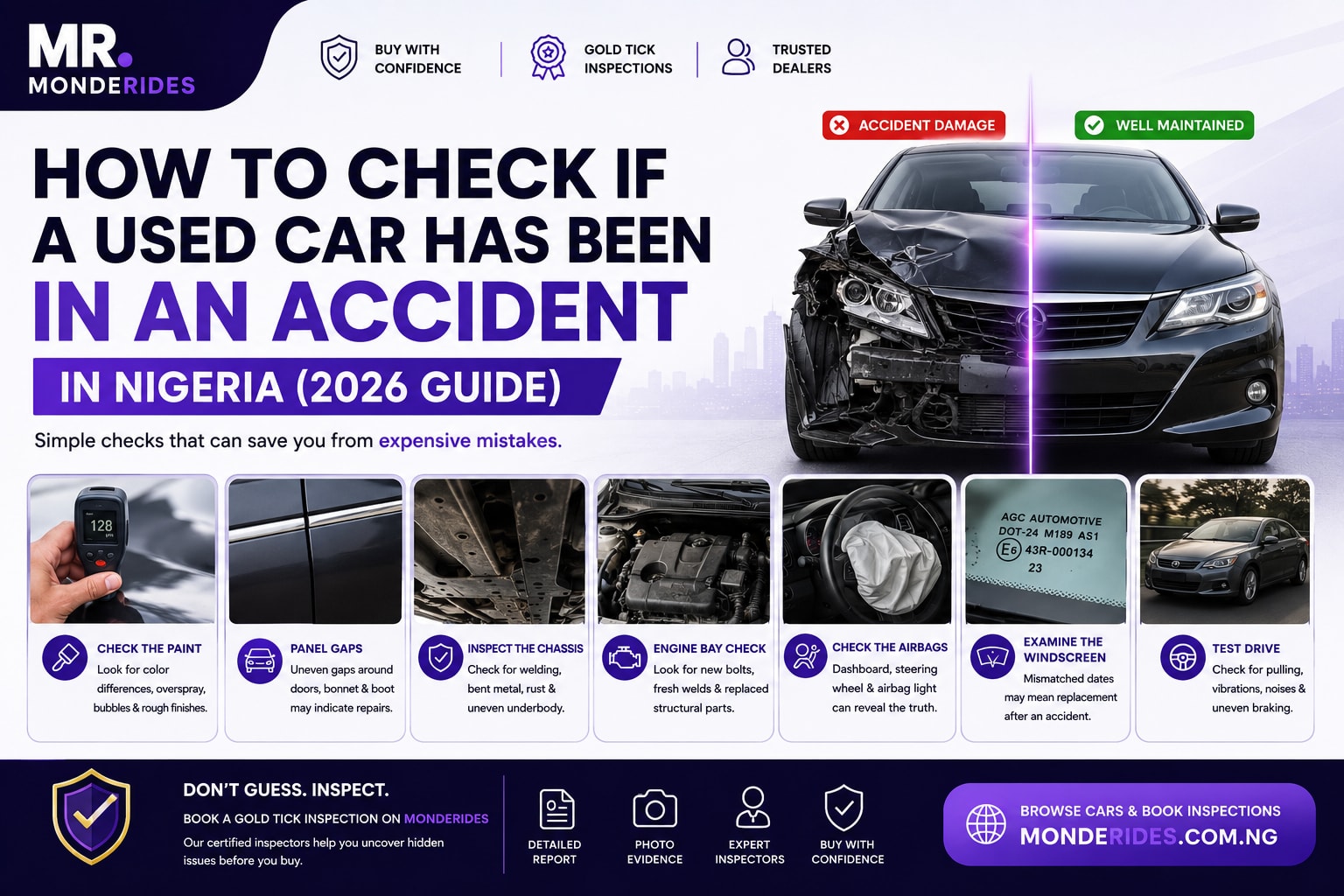
Inspect the vehicle carefully for:
- Accident repairs
- Flood damage
- Uneven body panels
- Repainted sections
- Chassis damage
- Welding
- Corrosion
- Oil leaks
- Warning lights
- Worn suspension components
- Transmission problems
- Engine problems
- Damaged electrical systems
- Signs of tampering
Pay particular attention to areas where repairs may be hidden.
For example, a freshly polished exterior does not tell you whether the vehicle has previously suffered major accident damage.
MondeRides already has detailed guides covering several of these checks:
- How to Check if a Used Car Has Been in an Accident in Nigeria
- How to Spot a Flood-Damaged Car in Nigeria
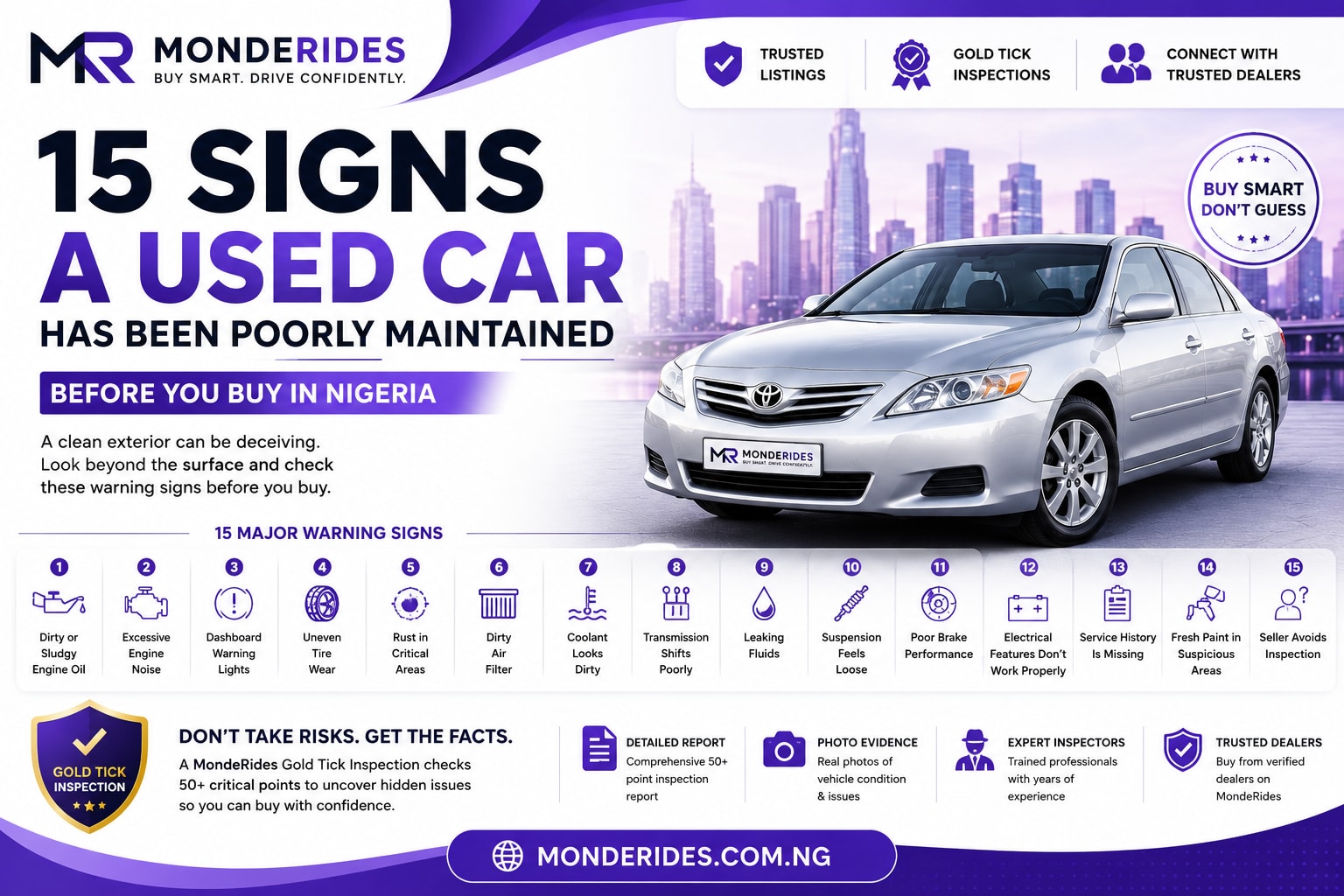
- 15 Signs a Used Car Has Been Poorly Maintained
- How to Check if a Used Car Engine Is Healthy
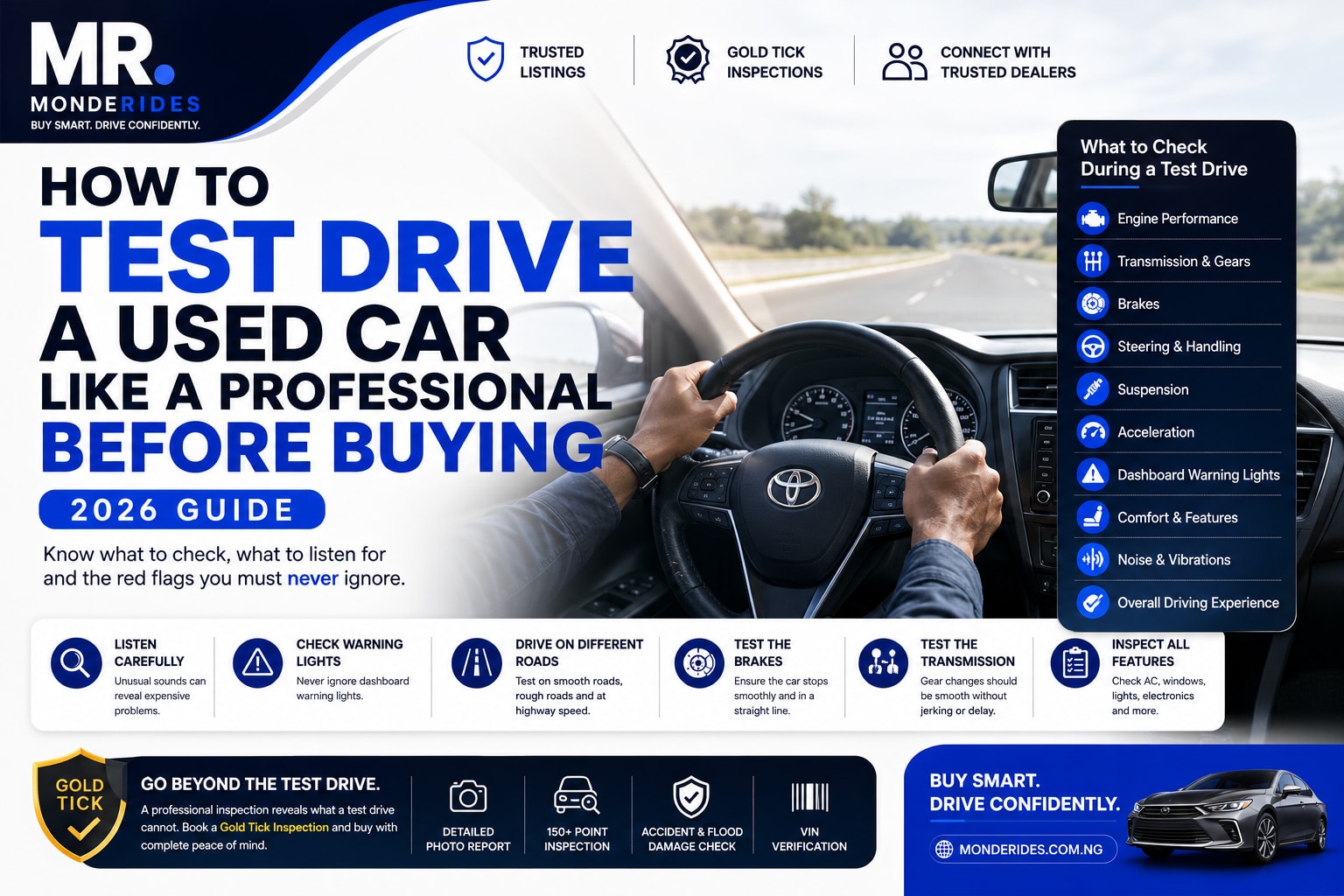
6. Get a Professional Mechanical Inspection
If you are not a mechanic, don't try to make a major purchase based entirely on your own inspection.
A professional inspection can identify issues that an ordinary buyer may miss.
The inspection should ideally cover:
Engine
Check for:
- Abnormal engine noise
- Oil leaks
- Excessive smoke
- Overheating
- Warning lights
- Poor idle
- Evidence of previous repairs
Transmission
Check for:
- Delayed engagement
- Jerking
- Slipping
- Unusual noises
- Transmission-fluid problems
Suspension
Inspect:
- Shock absorbers
- Bushings
- Ball joints
- Control arms
- Steering components
Braking system
Check:
- Brake response
- Brake noise
- Disc condition
- Brake-pad condition
- Warning lights
Electrical system
Test:
- Headlights
- Indicators
- Air conditioning
- Power windows
- Central locking
- Infotainment
- Dashboard warning lights
- Reverse camera and sensors where fitted
A professional inspection is particularly valuable when the vehicle is expensive or has an unclear history.
7. Verify the Seller and the Transaction
Even a genuine vehicle can become a dangerous transaction if you deal with the wrong person.
Before paying, consider:
- How long has the seller had the vehicle?
- Is the seller willing to provide documentation?
- Does the seller allow independent inspection?
- Is the seller pressuring you to pay immediately?
- Does the payment account belong to the appropriate person or business?
- Is the seller refusing to allow verification?
- Is the seller offering a price that seems suspiciously low?
Beware of unnecessary urgency
One of the most common psychological tactics in vehicle sales is creating artificial urgency.
For example:
"Another buyer is coming in 30 minutes."
"Send the deposit now or I'll sell it."
"You don't need to inspect it; I'm a trusted dealer."
You do not need to rush a transaction involving millions of naira.
A legitimate seller should understand why a serious buyer wants to verify the vehicle.
A Simple Car Verification Checklist
Before paying for a used car in Nigeria, make sure you can answer yes to the important questions below.
| Check | What you are confirming | | ---------------- | -------------------------------------------------------- | | VIN | The VIN physically matches the documentation | | Chassis | Identifying details are consistent | | Customs | Imported vehicle clearance/duty status has been verified | | Ownership | Seller has legitimate authority to sell | | Registration | Vehicle registration information is consistent | | Documents | Vehicle and ownership information matches | | Accident history | No unexplained major damage | | Flood history | No obvious signs of flood damage | | Engine | Engine condition has been professionally assessed | | Transmission | Transmission operates correctly | | Test drive | Vehicle performs normally | | Seller | Seller is willing to allow independent verification |
If several of these checks fail, do not let the asking price pressure you into buying.
5 Red Flags That Should Make You Stop the Deal
Some problems deserve more attention than others.
1. The VIN does not match
If the VIN on the vehicle differs from the VIN on the documentation, stop and investigate.
2. The seller refuses independent inspection
A seller who refuses to let you have the vehicle inspected should immediately raise your suspicion.
3. Missing or questionable documents
If important documentation is missing, don't assume you can "sort it out later."
4. The seller is rushing payment
Pressure to pay before verification is a major warning sign.
5. The price is dramatically below the market
An unusually cheap car may have an unusually expensive problem.
Before celebrating the bargain, find out why it is so cheap.
Can You Verify a Car Completely Online?
Not completely.
Online verification tools are extremely useful, but they should form part of a broader due-diligence process.
For example:
Online checks can help with:
- VIN information
- Customs status
- Ownership verification
- Certain registration information
But online checks cannot replace:
- Physical inspection
- Mechanical inspection
- Test driving
- Examination of the actual vehicle
- Verification of the seller
The safest approach is therefore:
Online verification + document verification + physical inspection + professional mechanical inspection.
What If the Seller Says "The Car Is Clean"?
Ask for evidence.
A clean vehicle should survive reasonable questions.
Instead of asking:
"Is the car clean?"
Ask:
"Can I independently verify the VIN, ownership, customs status and condition before payment?"
That changes the conversation from trust to evidence.
A genuine seller should have little reason to object to reasonable due diligence.
Should You Pay Before Verification?
No.
Avoid paying a substantial deposit or completing the purchase before you have completed the checks that matter.
If a seller demands payment before allowing you to inspect or verify the vehicle, consider that a serious warning sign.
Your money should come after your due diligence, not before it.
How MondeRides Helps Buyers Reduce the Risk
Buying a used car should not feel like a guessing game.
At MondeRides, vehicle verification is central to our approach to safer automotive transactions.
Our Gold Tick Inspection is designed to give buyers an additional layer of confidence by assessing vehicles against a structured inspection process.
However, buyers should still perform appropriate documentation and ownership checks. A vehicle inspection is not a substitute for legal or ownership verification.
The goal is simple:
Don't just buy a car because it looks good. Know what you're buying.
Frequently Asked Questions
How do I verify a car before buying in Nigeria?
Start by checking the vehicle's VIN and chassis details, then verify customs status where applicable, confirm ownership and registration information, inspect the documentation, and have the vehicle professionally inspected before payment.
How can I check a car VIN in Nigeria?
Locate the VIN physically on the vehicle and compare it with the VIN on the documentation. You can then use appropriate VIN verification resources to investigate the vehicle's identity and history. MondeRides also provides a detailed guide on how to check a car VIN in Nigeria.
How do I check if a car is cleared by Customs in Nigeria?
Nigeria Customs Service's Customs Verification Management System uses the vehicle VIN or chassis number to verify vehicle clearance and duty status.
How do I verify vehicle ownership in Nigeria?
The FRSC provides a Proof of Ownership Verification Platform that allows users to verify vehicle ownership information.
Can a car have genuine documents and still have problems?
Yes. Documentation verification and mechanical verification answer different questions. A vehicle can have valid documentation and still have accident damage, mechanical faults, flood damage or other problems.
Should I buy a car without seeing the original documents?
You should exercise extreme caution. Before completing a purchase, establish that the vehicle's documentation is legitimate and that the relevant identifying information matches the actual vehicle.
Should I inspect a used car before paying?
Yes. A proper inspection before payment can help identify mechanical, structural and cosmetic problems that may not be obvious from photographs or a short conversation with the seller.
Final Advice: Verify Before You Transfer the Money
The safest car purchase is not necessarily the cheapest one.
It is the one where you understand what you are buying, who owns it, where it came from, what its documents say and what condition it is actually in.
Before buying a used car in Nigeria, remember:
VIN → Customs → Ownership → Documents → Physical Inspection → Mechanical Inspection → Seller Verification
Don't skip the process because you are excited about the car.
A few hours of due diligence can save you millions of naira in repairs, legal complications or a bad transaction.
Buy smarter. Verify first.
Explore verified car listings on MondeRides
🎯 Key Takeaways
Learn how to verify a car before buying in Nigeria. Check the VIN, Customs status, ownership, documents, accident history and mechanical condition before paying.
🔍 Need a Professional Inspection?
Book a certified inspector to check the car before you buy. Peace of mind guaranteed.
Book an Inspector