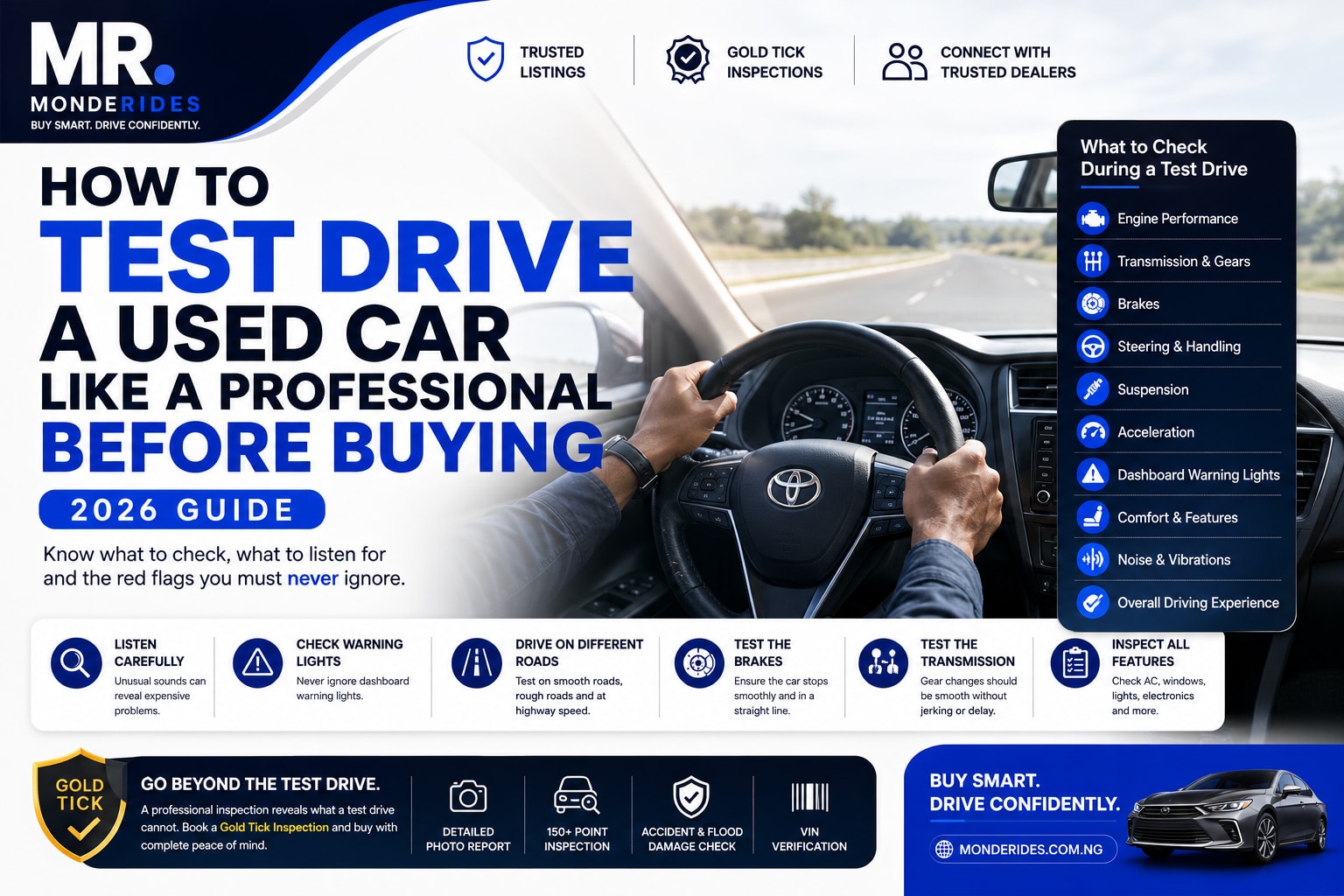
How to Test Drive a Used Car Like a Professional Before Buying (2026 Guide)
Buying a used car is one of the biggest financial decisions many Nigerians make. Unfortunately, many buyers spend hours checking the vehicle's exterior but only a few minutes behind the wheel before making payment.
A proper test drive can reveal problems that photographs, advertisements, and even a quick visual inspection cannot.
In this guide, you'll learn exactly how professional inspectors test drive used cars and what warning signs you should never ignore.
Why a Test Drive Is So Important
A vehicle may look clean on the outside but still have hidden problems such as:
- Transmission issues
- Suspension damage
- Steering problems
- Engine performance issues
- Brake failure
- Wheel alignment problems
- Electrical faults
A thorough test drive helps you identify many of these issues before you buy.
Before You Start Driving
Before turning the key, carry out a quick inspection.
Check:
- Tire condition
- Uneven tire wear
- Fluid leaks under the vehicle
- Body panel alignment
- Windshield condition
- Dashboard warning lights
If something already looks suspicious, investigate before driving.
Step 1: Start the Engine Cold
Whenever possible, inspect the vehicle before the seller warms it up.
A cold engine reveals more problems than a warm one.
Watch for:
- Hard starting
- Excessive cranking
- Rough idle
- Blue smoke
- White smoke
- Black smoke
The engine should start quickly and idle smoothly.
Step 2: Listen Carefully
Turn off the radio.
Open the windows.
Listen carefully.
Unusual sounds often reveal expensive mechanical problems.
Be alert for:
- Knocking
- Ticking
- Grinding
- Squealing
- Rattling
- Hissing
A healthy Toyota, Honda or Lexus engine should sound smooth and consistent.
Step 3: Check the Dashboard
Before moving the vehicle, ensure warning lights disappear after the engine starts.
Watch for:
- Check Engine Light
- ABS Warning
- Airbag Light
- Battery Light
- Oil Pressure Light
- Transmission Warning
Any warning light deserves further investigation.
Step 4: Test the Steering
Drive slowly in an open area.
The steering should feel:
- Smooth
- Responsive
- Stable
It should not:
- Pull left
- Pull right
- Vibrate excessively
- Feel unusually heavy
Poor steering can indicate suspension or alignment problems.
Step 5: Test the Brakes
Find a safe road.
Brake gently first.
Then perform a slightly firmer stop.
The vehicle should:
- Stop in a straight line
- Feel stable
- Produce no grinding sounds
- Have a firm brake pedal
Warning signs include:
- Brake vibration
- Pulling to one side
- Squealing
- Soft brake pedal
Step 6: Test the Transmission
Automatic Transmission
The gear changes should feel smooth.
Watch for:
- Delayed engagement
- Hard shifting
- Jerking
- Slipping
- High engine revs with little acceleration
Manual Transmission
Check:
- Smooth clutch engagement
- Easy gear selection
- No clutch slipping
- No grinding when changing gears
Transmission repairs are among the most expensive used-car repairs.
Step 7: Drive Over Uneven Roads
Nigeria's roads provide a perfect suspension test.
Drive carefully over:
- Speed bumps
- Rough patches
- Small potholes
Listen for:
- Clunks
- Knocks
- Suspension squeaks
- Loose components
A healthy suspension should absorb bumps without excessive noise.
Step 8: Test Acceleration
Find a safe stretch of road.
Accelerate gradually.
The vehicle should:
- Respond smoothly
- Shift properly
- Accelerate without hesitation
Watch for:
- Engine hesitation
- Misfires
- Excessive smoke
- Loss of power
Step 9: Test at Highway Speed
If road conditions allow, drive at higher speeds.
Observe:
- Steering stability
- Cabin vibrations
- Wind noise
- Engine performance
Excessive vibration may indicate:
- Bent wheels
- Poor wheel balancing
- Suspension damage
- Accident repairs
Step 10: Reverse the Vehicle
Many buyers forget this step.
Reverse parking helps identify:
- Steering problems
- Gearbox issues
- Parking sensor faults
- Reverse camera problems
Always test reverse before buying.
Step 11: Test Every Feature
Don't focus only on driving.
Check every major feature.
Including:
- Air conditioning
- Power windows
- Door locks
- Mirrors
- Headlights
- Brake lights
- Horn
- Wipers
- Reverse camera
- Parking sensors
- Infotainment system
Small electrical faults can become expensive later.
Red Flags During a Test Drive
Walk away—or request a professional inspection—if you notice:
- Engine knocking
- Transmission slipping
- Heavy smoke
- Brake failure
- Steering vibration
- Overheating
- Dashboard warning lights
- Burning smell
- Fluid leaks
- Loud suspension noises
These may indicate major repairs.
Common Mistakes Buyers Make
Many Nigerians:
- Drive for only five minutes
- Ignore warning lights
- Leave the radio playing
- Never test reverse gear
- Skip highway driving
- Fail to inspect underneath the vehicle
- Buy immediately after a short drive
A proper test drive usually takes 20–30 minutes.
Why a Test Drive Isn't Enough
Even an excellent test drive cannot detect everything.
Hidden issues may still include:
- Flood damage
- Chassis repairs
- Odometer rollback
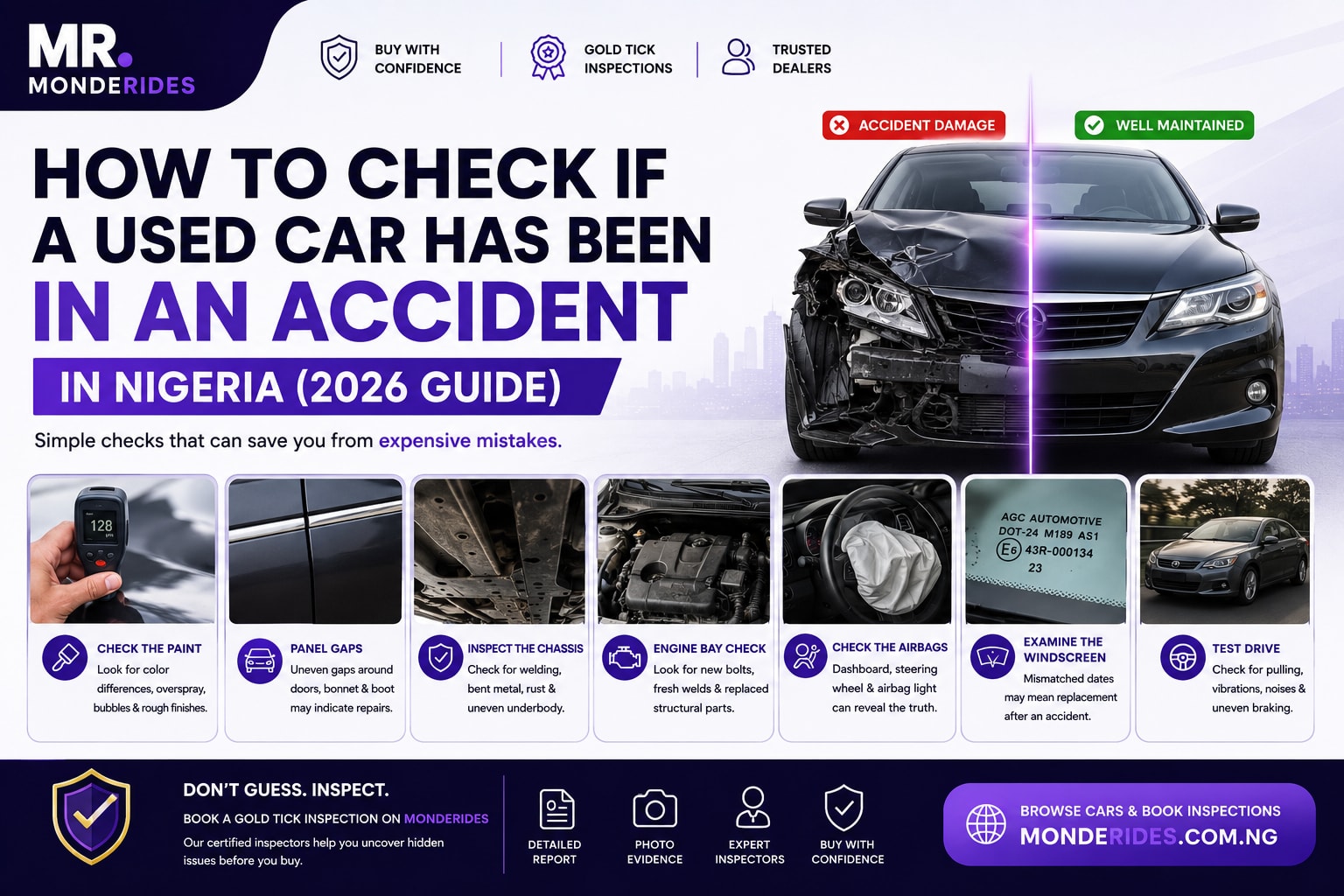
- Previous accident damage
- Engine compression problems
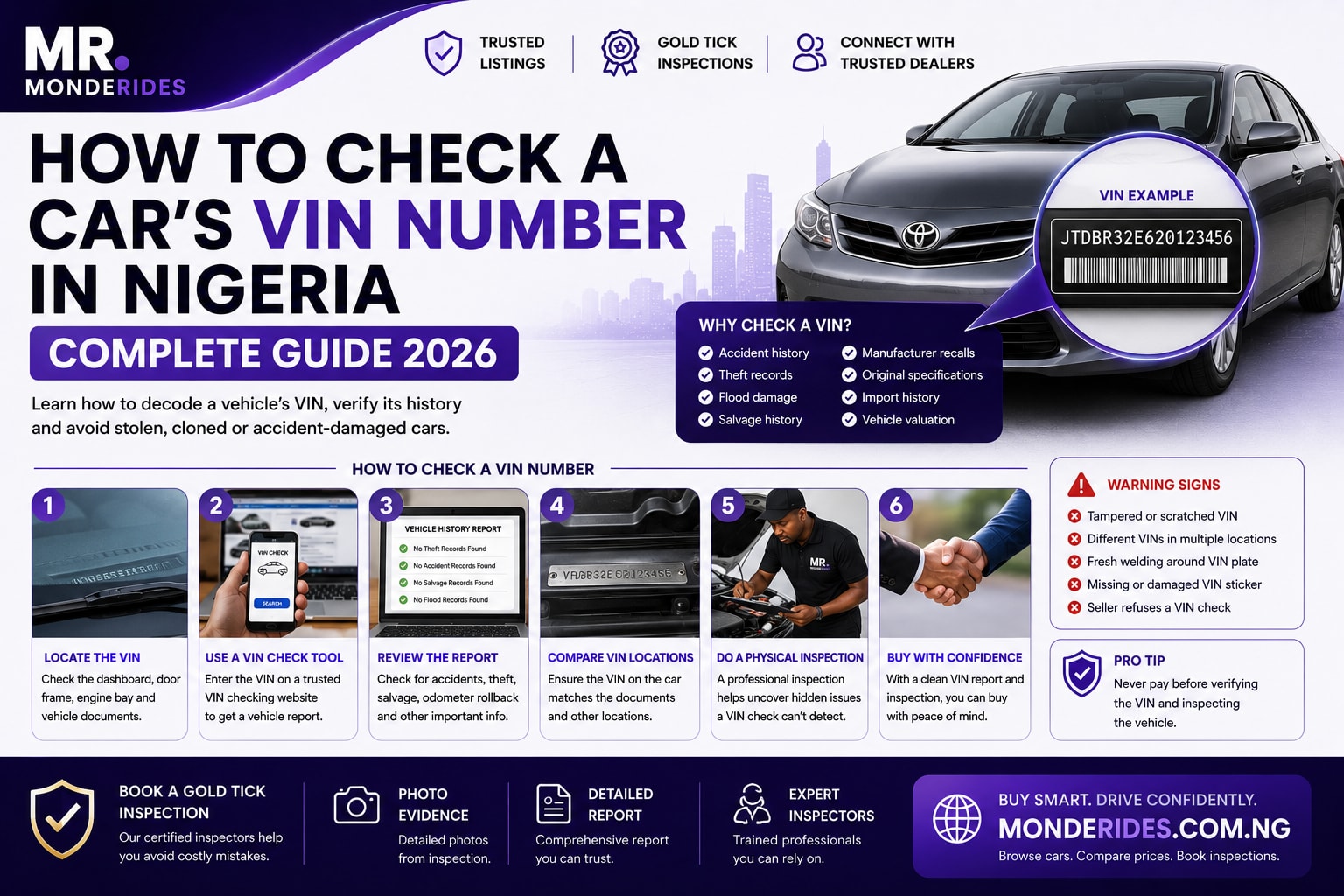
- VIN discrepancies
- Structural repairs
This is why professional inspections remain essential.
Book a Gold Tick Inspection
A MondeRides Gold Tick Inspection goes far beyond a normal test drive.
Our inspectors perform a comprehensive inspection covering:
- Engine
- Transmission
- Suspension
- Brakes
- Electrical system
- Chassis
- Paintwork
- Accident history
- VIN verification
- Detailed photo report
You'll know exactly what you're buying before making payment.
Frequently Asked Questions
How long should a used car test drive last?
Ideally, between 20 and 30 minutes, covering city roads, rough roads, and higher-speed driving where safe.
Should I drive the car before buying?
Yes. Never buy a used car without driving it first.
Can a test drive detect accident damage?
Sometimes, but not always. Professional inspections are still recommended because structural repairs may not be obvious during driving.
What is the biggest warning sign during a test drive?
Persistent dashboard warning lights, transmission slipping, heavy smoke, overheating, unusual engine noises, or steering instability.
Final Verdict
A proper test drive is one of the best ways to protect yourself from buying a problematic vehicle.
Take your time. Drive in different road conditions. Listen carefully. Test every major system.
However, remember that even the best test drive cannot uncover every hidden issue.
For complete peace of mind, combine your test drive with a MondeRides Gold Tick Inspection. Our certified inspectors help uncover accident damage, flood damage, hidden mechanical faults, and VIN discrepancies before you buy.
Buying smart isn't just about finding the right car—it's about making sure the car is exactly what the seller claims it is.
Buy Smart. Drive Confidently.
🎯 Key Takeaways
Learn how to properly test drive a used car before buying. Discover what to check, common warning signs, and how to avoid costly mistakes in Nigeria.
🔍 Need a Professional Inspection?
Book a certified inspector to check the car before you buy. Peace of mind guaranteed.
Book an Inspector