Why Low Mileage Doesn't Always Mean a Better Used Car in Nigeria
When shopping for a used car in Nigeria, one of the first questions buyers ask is:
"How many kilometres has it covered?"
Many people immediately assume that the lower the mileage, the better the car.
While mileage is certainly an important factor, it is far from the most important.
In fact, some of the most reliable used cars on Nigerian roads today have over 180,000 kilometres, while some cars with less than 50,000 kilometres have become financial nightmares for their owners.
The truth is simple:
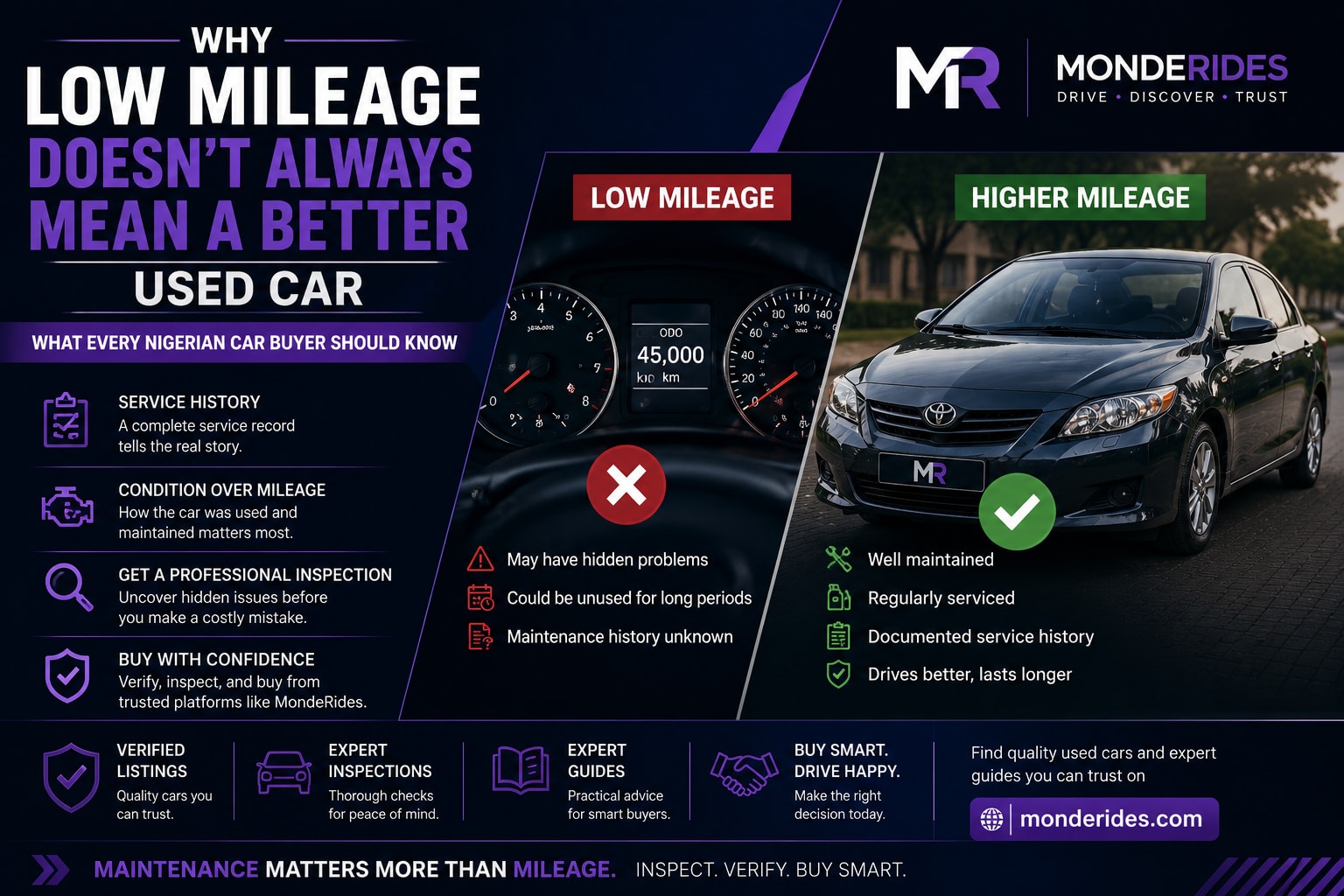
Mileage tells you how far a car has travelled—not how well it has been cared for.
Understanding this difference could save you millions of naira.
Why Buyers Focus Too Much on Mileage
There's a reason mileage gets so much attention.
A car that has travelled fewer kilometres has, in theory:
- Experienced less engine wear
- Been driven for fewer hours
- Used fewer suspension components
- Consumed less of its mechanical lifespan
That's true...
But only if the vehicle has been properly maintained.
Unfortunately, that's a very big assumption.
A Well-Maintained Car Beats a Low-Mileage Car
Imagine two Toyota Corollas.
Car A
- 62,000 km
- Oil changed once every two years
- Poor-quality engine oil
- Never serviced properly
- Parked outside constantly
Car B
- 185,000 km
- Full service history
- Oil changed every 5,000–8,000 km
- Transmission serviced
- Suspension maintained
- Garaged most of its life
Which one would most mechanics choose?
Surprisingly...
Many would recommend Car B.
Maintenance almost always matters more than the number on the odometer.
Cars Are Designed to Be Driven
Many buyers don't realize this.
Cars are mechanical machines.
They actually perform better when used regularly.
A vehicle that sits unused for months—or even years—can develop problems such as:
- Weak batteries
- Hardened rubber seals
- Dry engine gaskets
- Rust
- Brake seizure
- Fuel contamination
- Flat-spotted tyres
Ironically, the "low mileage" car may require more repairs than the one that has been driven consistently.
Nigerian Roads Tell a Different Story
Mileage doesn't tell you where the car travelled.
Consider these two cars.
One covered:
- 120,000 km almost entirely on smooth highways.
The other covered:
- 60,000 km driving daily through potholes, flooded roads and heavy Lagos traffic.
Which suspension has suffered more?
Probably the second.
Road conditions dramatically affect a vehicle's lifespan.
Driving Style Matters
Two people can drive the same car for the same distance...
...and produce completely different levels of wear.
Aggressive driving causes:
- Faster brake wear
- Premature tyre wear
- Suspension damage
- Transmission stress
- Engine strain
Gentle drivers often keep vehicles in excellent condition even after high mileage.
Service History Is Worth More Than Mileage
One of the smartest questions you can ask a seller is:
"Do you have service records?"
A documented maintenance history tells you:
- Oil change frequency
- Major repairs
- Transmission servicing
- Cooling system maintenance
- Brake replacements
A car with proper records is usually a much safer purchase than one with low mileage but no history.
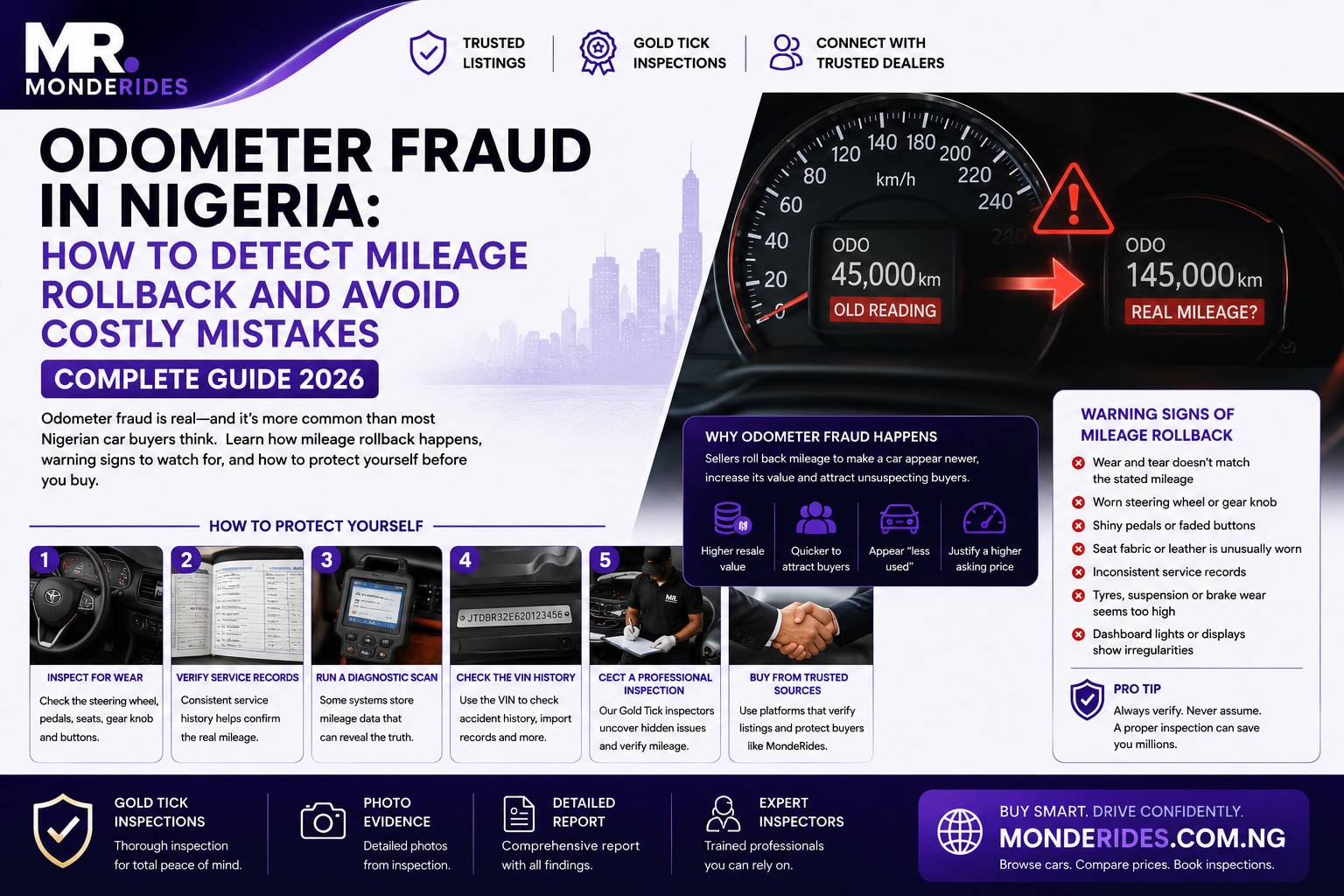
Beware of Odometer Fraud
Unfortunately, odometer rollback still happens.
Unscrupulous sellers sometimes reduce the displayed mileage to increase a vehicle's value.
Watch out for warning signs such as:
- Worn steering wheel
- Shiny pedals
- Torn driver's seat
- Heavy gear lever wear
- Mismatched service records
If the car looks heavily used but claims extremely low mileage, investigate further.
Look Beyond the Dashboard
Before buying any used car, inspect:
Engine
- Smooth idle
- No knocking sounds
- No excessive smoke
Transmission
- Smooth gear changes
- No slipping
- No harsh engagement
Suspension
- No unusual noises
- Stable ride quality
Interior
- Seat condition
- Dashboard
- Controls
- Electronics
Exterior
- Paint consistency
- Accident repairs
- Rust
- Panel alignment
These reveal far more than mileage alone.
Don't Ignore a Professional Inspection
This is one of the best investments you can make.
A professional inspection can uncover:
- Hidden accident repairs
- Flood damage
- Electrical faults
- Suspension wear
- Engine issues
- Transmission problems
Problems you may never notice during a short test drive.
Common Mistakes Buyers Make
❌ Buying solely because of low mileage
❌ Ignoring maintenance history
❌ Skipping inspection
❌ Trusting the seller without verification
❌ Not checking for accident repairs
What Really Makes a Good Used Car?
Instead of asking only:
"How many kilometres?"
Ask:
- Has it been serviced regularly?
- Has it been inspected?
- Does it drive smoothly?
- Is there accident history?
- Is the paperwork complete?
Those answers matter far more.
Final Thoughts
Mileage is important—but it is only one piece of the puzzle.
A carefully maintained vehicle with higher mileage will often outperform a neglected low-mileage car.
The smartest buyers don't shop by numbers alone.
They evaluate the entire vehicle.
Frequently Asked Questions
Is 200,000 km too much?
Not necessarily. Many modern vehicles can exceed 300,000 km with proper maintenance.
Can mileage be faked?
Yes. Odometer rollback still exists, which is why inspections and documentation are important.
Should I buy a high-mileage Toyota?
If it has been well maintained and passes inspection, it can be an excellent purchase.
Buy Smarter With MondeRides
At MondeRides, we believe informed buyers make better decisions.
That's why we're building more than a marketplace.
Browse quality vehicle listings, learn from expert buying guides, and make confident purchasing decisions with MondeRides—Nigeria's trusted automotive platform.
🎯 Key Takeaways
Many buyers assume a low-mileage used car is automatically a better purchase. Learn why mileage alone doesn't tell the full story and what you should inspect before buying.