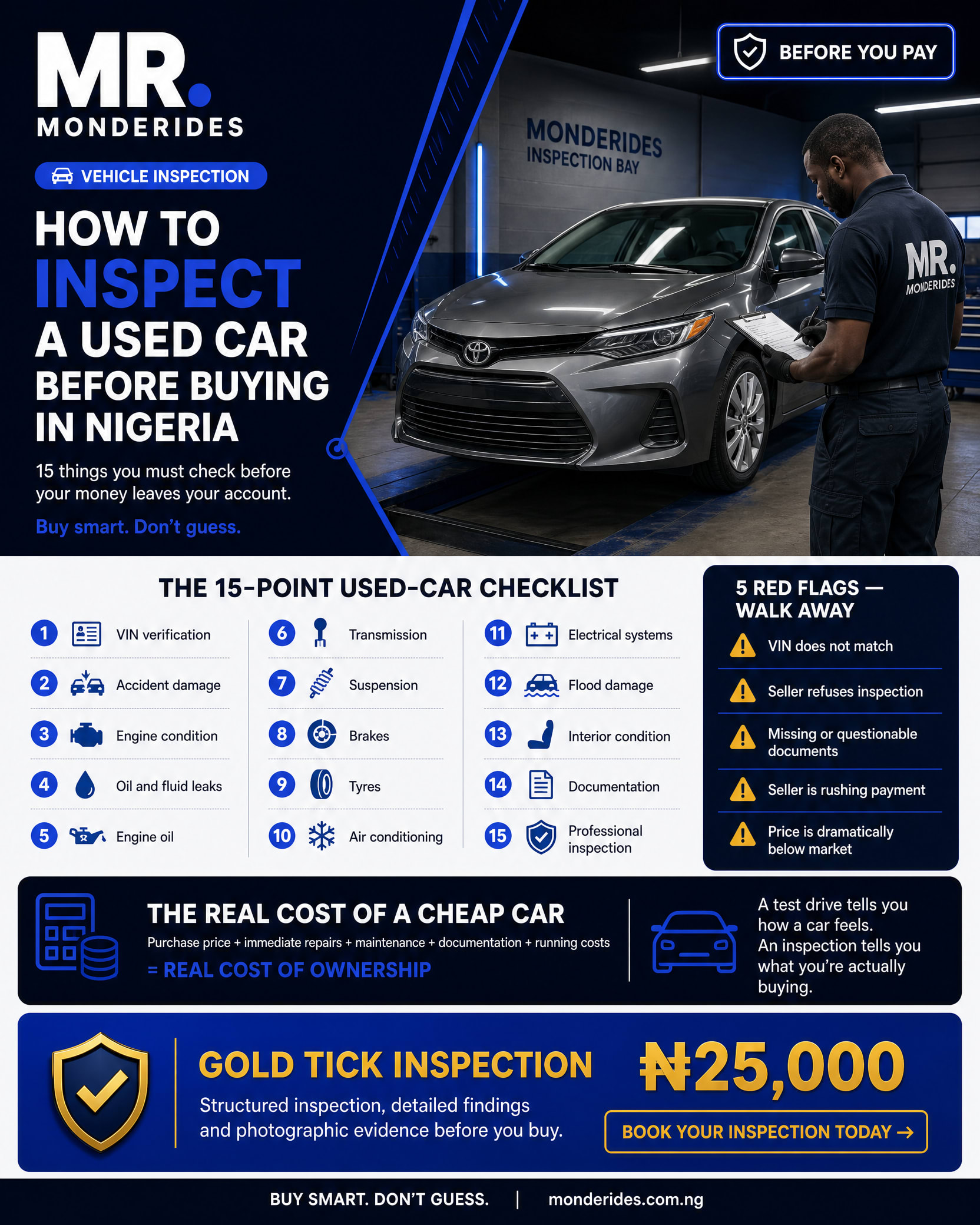
How to Inspect a Used Car Before Buying in Nigeria: 15 Things You Must Check
Buying a used car can save you millions of naira compared with buying new.
But there is a problem.
A car can look clean, drive smoothly during a short test drive and still have expensive problems hiding underneath.
Previous accident damage, overheating, transmission problems, flood damage, engine issues, electrical faults and questionable documentation can turn an attractive deal into a financial nightmare.
That is why a proper inspection should happen before you pay, not after.
At MondeRides, we believe you should buy smart, not guess.
Here are 15 important things to check before buying a used car in Nigeria.
1. Check the Vehicle Identification Number (VIN)
Start with the VIN.
The VIN is the vehicle's unique identification number and can help you verify important information about the car.
Check that the VIN on the vehicle matches the VIN shown on its documentation.
Look for the VIN in locations such as:
- Dashboard near the windscreen
- Driver-side door frame
- Engine bay
- Vehicle documentation
If the VIN appears altered, damaged, missing or inconsistent across different documents, stop and investigate before proceeding.
A suspicious VIN should never be ignored simply because the car looks good.
2. Inspect the Body for Accident Damage
Don't only look at whether the car is shiny.
Look at the body panels carefully.
Check for:
- Uneven gaps between panels
- Different shades of paint
- Overspray around rubber seals
- Paint bubbling
- Cracked headlights or taillights
- Misaligned bumpers
- Signs of welding
- Replaced body panels
A freshly painted panel isn't automatically a problem.
The important question is why was it painted?
Minor cosmetic repairs are normal on used vehicles. Significant structural repairs are a different matter.
3. Check the Engine Before It Gets Warm
If possible, inspect the vehicle when the engine is cold.
A seller may warm up a vehicle before you arrive to hide certain symptoms.
Listen carefully when the engine starts.
Look for:
- Excessive knocking
- Ticking sounds
- Rough idle
- Excessive vibration
- Difficult starting
- Unusual smoke
- Warning lights on the dashboard
A healthy-looking engine bay does not necessarily mean the engine itself is healthy.
4. Inspect for Oil and Fluid Leaks
Look underneath the vehicle.
Check for signs of:
- Engine oil leaks
- Transmission fluid leaks
- Coolant leaks
- Brake fluid leaks
- Power steering fluid leaks
Also inspect around the engine bay for wet or freshly cleaned areas.
A completely clean engine bay isn't necessarily proof of good maintenance. Sometimes an engine bay has been washed specifically to hide leaks.
5. Examine the Engine Oil
Engine oil can tell you a surprising amount about a vehicle.
Check the oil level and appearance using the dipstick where applicable.
Pay attention to:
- Extremely low oil level
- Thick sludge
- Unusual smell
- Metallic particles
- Milky or creamy appearance
The condition of the oil should be considered alongside the vehicle's service history and other inspection findings.
6. Test the Transmission Properly
Transmission problems can be among the most expensive problems to repair.
During the test drive, pay attention to how the vehicle changes gears.
Look for:
- Delayed engagement
- Hard shifting
- Jerking
- Slipping
- Unusual noises
- Difficulty selecting gears
- Transmission warning lights
For automatic vehicles, test the transmission in different driving conditions.
For manual vehicles, check the clutch engagement and gear selection.
Don't accept "that's normal for this model" without having the vehicle properly assessed.
7. Check the Suspension
Nigeria's roads can be demanding on suspension components.
Drive over different road surfaces where it is safe to do so.
Listen for:
- Knocking
- Clunking
- Squeaking
- Excessive bouncing
- Steering vibration
Also inspect the tyres for uneven wear.
Uneven tyre wear can sometimes indicate alignment, suspension or steering problems.
8. Inspect the Braking System
Brakes should never be treated as a minor issue.
During a safe test drive, check whether the vehicle stops smoothly and confidently.
Watch for:
- Brake vibration
- Pulling to one side
- Squealing
- Grinding
- Excessive pedal travel
- Brake warning lights
If braking feels abnormal, have the braking system professionally inspected before purchasing.
9. Check the Tyres
Look at all four tyres carefully.
Check:
- Tread depth
- Uneven wear
- Cracks
- Bulges
- Punctures
- Tyre age
- Matching or mismatched tyres
Also inspect the spare tyre.
A vehicle with four different tyres isn't automatically bad, but unusual tyre combinations can sometimes reveal how the vehicle has been maintained.
10. Test the Air Conditioning
In Nigeria, air conditioning isn't exactly a luxury.
Test the AC properly.
Don't simply turn it on for 30 seconds.
Allow it to run and check:
- How quickly it gets cold
- Whether cooling remains consistent
- Fan speeds
- Unusual smells
- Strange noises
- Whether the compressor engages properly
A weak AC system can become an expensive repair.
11. Test the Electrical Systems
Modern cars contain many electronic systems.
Test as many as possible, including:
- Headlights
- Brake lights
- Indicators
- Hazard lights
- Reverse lights
- Power windows
- Central locking
- Wipers
- Interior lights
- Infotainment
- Cameras
- Parking sensors
- Electric seats
- Sunroof, where applicable
Don't assume that because the engine works, everything else does too.
12. Look for Signs of Flood or Water Damage
Flood-damaged vehicles can be particularly difficult to identify once they have been cleaned and repaired.
Look for:
- Damp or unusual smells
- Rust in unusual places
- Corrosion around electrical connectors
- Water stains
- Mud or debris in hidden areas
- Damaged carpet
- Corrosion underneath seats
- Electrical problems
Be especially careful with imported used vehicles whose history you cannot independently verify.
13. Check the Interior for More Than Appearance
The interior can reveal how a vehicle was used.
Inspect:
- Seat condition
- Steering wheel wear
- Pedal wear
- Gear selector
- Dashboard
- Seat belts
- Carpet
- Roof lining
- Door panels
Compare the interior wear with the claimed mileage.
For example, extremely worn pedals and steering controls combined with unusually low mileage should make you ask more questions.
Mileage alone should never determine whether a car is a good purchase.
14. Verify the Documents
Never buy a vehicle based solely on the seller's word.
Check the available documentation and ensure the information corresponds with the actual vehicle.
Depending on the vehicle and transaction, documentation may include:
- Vehicle registration documents
- Customs/importation documentation where applicable
- Proof of ownership
- Insurance documentation
- Service records
- Other relevant vehicle paperwork
If something doesn't match, don't rush the transaction.
Ask questions and verify.
15. Get a Professional Inspection
This is the step many buyers skip.
And it can be the most important one.
You may know how to drive a car without knowing how to diagnose one.
A professional inspection can uncover problems that aren't obvious during a normal viewing or test drive.
A proper inspection should assess areas such as:
- Engine
- Transmission
- Suspension
- Brakes
- Steering
- Electrical systems
- Body condition
- Tyres
- Interior
- Cooling system
- Signs of accident damage
- Signs of water damage
- Vehicle documentation
At MondeRides, our Gold Tick Inspection is designed to help buyers make more informed decisions before purchasing a vehicle.
Instead of relying only on what the seller tells you, you get a structured inspection process, detailed findings and photographic evidence.
Don't Let a Cheap Car Become an Expensive Mistake
The cheapest car isn't always the best deal.
A vehicle that costs ₦20 million but immediately requires ₦4 million in repairs may be a worse purchase than a properly maintained vehicle costing ₦22 million.
When buying a used car, think beyond the asking price.
Consider:
Purchase price + immediate repairs + maintenance + documentation + running costs
That is the real cost of ownership.
Used Car Inspection Checklist
Before paying for a used vehicle, make sure you've considered:
- [ ] VIN verification
- [ ] Accident damage
- [ ] Engine condition
- [ ] Oil and fluid leaks
- [ ] Engine oil
- [ ] Transmission
- [ ] Suspension
- [ ] Brakes
- [ ] Tyres
- [ ] Air conditioning
- [ ] Electrical systems
- [ ] Flood damage
- [ ] Interior condition
- [ ] Documentation
- [ ] Professional inspection
If you cannot confidently check these yourself, bring someone who can.
Buy Smart. Don't Guess.
A test drive can tell you how a car feels.
An inspection can tell you what you're actually buying.
Before you spend millions of naira on a used vehicle, take the time to verify its condition, history and documentation.
Looking for a car in Nigeria? Explore trusted vehicle listings on MondeRides and connect with verified dealers.
Need a professional vehicle inspection? Ask about MondeRides Gold Tick Inspection.
Frequently Asked Questions
How much does a car inspection cost in Nigeria?
Inspection costs vary depending on the vehicle, location and depth of the inspection. Always confirm the inspection scope and price before booking.
Should I inspect a car before paying a deposit?
Yes. Ideally, conduct your inspection before making a significant financial commitment. If a deposit is unavoidable, understand the refund terms clearly.
Can a mechanic detect accident damage?
An experienced mechanic or vehicle inspector can identify many signs of accident repairs, although no inspection can guarantee detection of every historical repair.
Should I buy a car that has been repainted?
Not necessarily a reason to reject the vehicle. The important thing is determining why it was repainted and whether the underlying repair was properly performed.
Is a test drive enough before buying a used car?
No. A test drive is useful, but it should be part of a broader inspection covering the vehicle's mechanical, electrical, structural and documentation condition.
What is a Gold Tick Inspection?
A MondeRides Gold Tick Inspection is a structured vehicle inspection designed to give buyers clearer information about a vehicle's condition before making a purchase decision.
🎯 Key Takeaways
Buying a used car in Nigeria without a proper inspection can turn a good deal into an expensive mistake. Here are 15 essential things to check before paying for any used vehicle.
🔍 Need a Professional Inspection?
Book a certified inspector to check the car before you buy. Peace of mind guaranteed.
Book an Inspector
